Why it happens
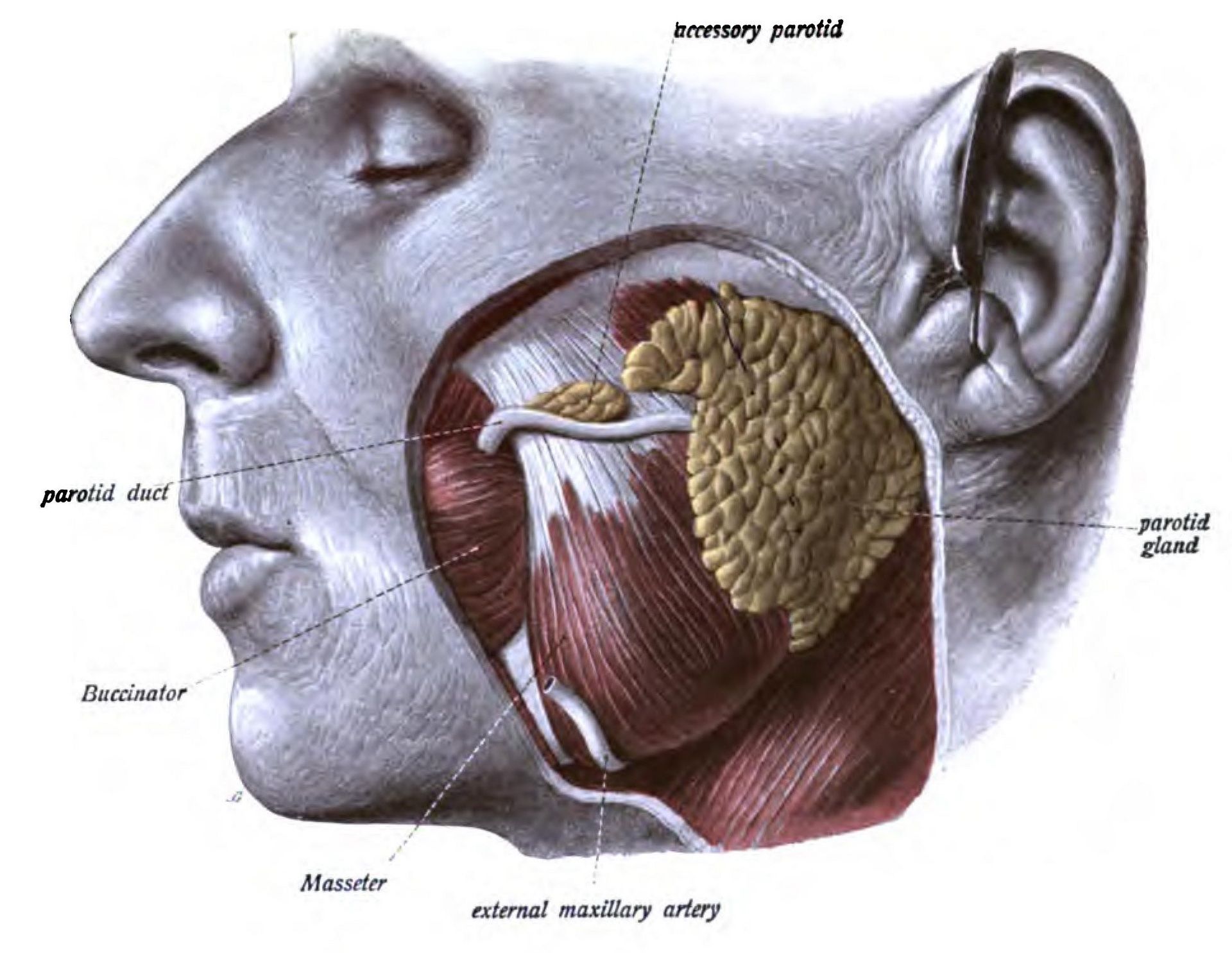
Saliva is made by three pairs of major glands: the parotid glands in front of the ears, the submandibular glands under the jaw, and the sublingual glands under the tongue. Each drains into the mouth through a fine duct. When you eat, the glands are stimulated to make more saliva. If the duct is blocked, saliva backs up and the gland swells.
The most common cause is a stone, formed from minerals in saliva. Most stones form in the submandibular gland, because its saliva is thicker and its long duct runs upwards to its opening under the tongue. In the parotid gland, a narrowing of the duct is a frequent cause. Mucus plugs and inflammation of the glands can also block the flow.
Other signs
Some people notice a salty or gritty taste, or can feel a small hard lump under the tongue. The swelling may come and go for months before it becomes a problem.
If saliva stays trapped, the gland can become infected. It is then swollen and tender all the time, the skin over it may be red, pus may come into the mouth, and you may have a fever. An infected gland needs to be seen by a doctor, and usually needs antibiotics.
What you can do at home
If the swelling is mild and comes and goes, these measures help, and occasionally let a small stone pass: drink plenty of water through the day; suck sour sweets or a slice of lemon to increase the flow of saliva; massage the gland gently forwards, towards the mouth; and apply warmth to the swelling.
See a doctor if the swelling keeps coming back, does not go down between meals, or comes with pus or a fever.
When it might be something else
A swelling that comes and goes with meals almost always means a blockage. A lump in a salivary gland that is always there, grows slowly and does not change with eating is different. Many such lumps are benign tumours, but they need proper assessment by a specialist, usually with an ultrasound and a fine needle sample.
Seek help promptly if a lump in front of the ear comes with weakness of the face. Go to an emergency unit if swelling spreads into the floor of the mouth or the neck and makes it difficult to swallow or breathe.
How it is diagnosed
Dr Kana examines the gland from inside and outside the mouth and looks at the opening of the duct. An ultrasound is usually the first scan; it shows most stones and the state of the gland. A CT scan is sometimes used to show the size and position of a stone. Sialendoscopy itself also shows exactly what is inside the duct.
Treatment that keeps the gland
A submandibular gland that kept blocking was once usually removed through a cut in the neck. Sialendoscopy offers another way. A scope about a millimetre wide is passed into the duct through its natural opening in the mouth. Small stones can be caught in a tiny basket and removed, and narrowings can be widened. Larger stones may need a small cut inside the mouth as well.
It is usually done under general anaesthetic, though some cases can be done under local, and most patients go home the same day. The gland is often swollen for a day or two afterwards.
In 2019 Dr Kana and Dr S Maharaj published a review of 15 patients and 17 glands treated with sialendoscopy between 2008 and 2018: 73.3% were treated successfully with the scope alone, without removing the gland, and the authors concluded that sialendoscopy should be the first-line approach. Not every gland can be kept. Very large stones, or a gland damaged by years of infection, may still need removal, and Dr Kana will discuss this with you.
This page is general information, not medical advice for your situation.